Why Static Retargeting Wastes Your Best Signals
Retargeting gets smarter when we turn first-party signals into audience rules instead of treating every site visitor the same. A product view, repeat visit, cart event, form submission, content click, purchase, or CRM stage can all show intent. That intent only matters if it reaches your ad platforms and outreach workflows while it is still fresh.
Customer data orchestration is the process of collecting, organizing, enriching, and routing those signals into usable audiences across Meta Ads, Google Ads, CRMs, and outbound tools. For an April Mother’s Day or summer campaign, a shopper who viewed premium gift bundles twice should not see the same ad as someone who only read a sizing guide. Below, we’ll cover how to map signals, resolve identity, automate updates, and measure impact on ROAS and CAC.
Build a Signal Map Before You Automate
Automation needs clear rules. Before we connect anything, we recommend deciding which behaviors matter, what they mean, and what action they should trigger.
Start by mapping signals in three groups:
- Website behavior: product views, pricing-page visits, cart abandonment, repeat sessions, and category browsing
- Customer record data: purchase frequency, average order value, email engagement, subscription status, and lead stage
- Time-based activity: a return visit within seven days, 90 days without a purchase, or a lead going quiet after a demo request
Not every signal deserves equal attention. A cart abandonment event usually has more commercial value than a blog read. For B2B teams, a pricing-page visit paired with a company-size match may justify immediate sales follow-up.
An apparel brand, for example, can separate high-value cart abandoners, returning customers, and first-time visitors. Each group gets its own creative, offer rules, and frequency cap. That is a much cleaner plan than putting everyone who touched the site into one large audience.
For every signal, document four fields: the event, audience condition, destination, and suppression rule. This small step prevents duplicate targeting, conflicting messages, and wasted spend.
Customer Data Orchestration Connects Signals to Action
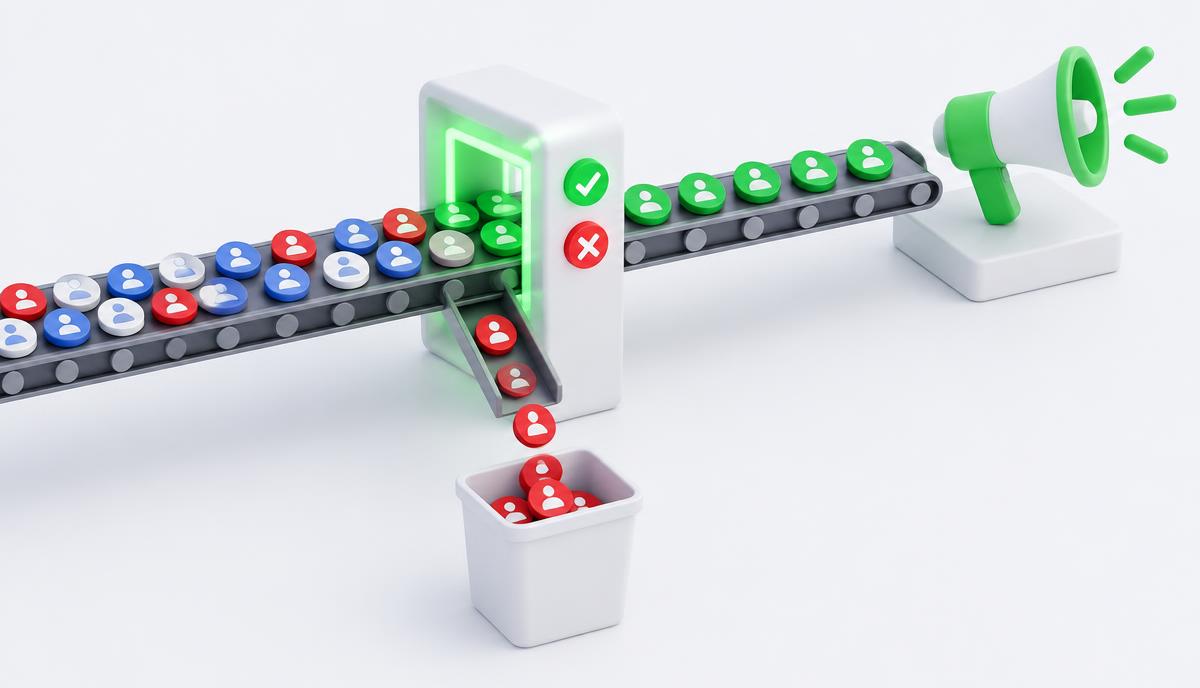
Customer data orchestration is the operational layer between raw activity and action. It moves customer and prospect signals from your website, CRM, ecommerce platform, email program, and enrichment sources into the places where your team can act on them.
A practical workflow looks like this:
- Capture activity through a website pixel, forms, ecommerce events, CRM updates, and email engagement
- Resolve identity when appropriate, connecting anonymous activity to known people or households in a privacy-conscious way
- Enrich records with relevant details, such as email, mobile, household income, job title, company data, or geography
- Route qualified records into ad audiences, CRM lists, and outbound sequences
At DataMoon, our pixel identifies website visitors at the person level. Our data graph supports audience building across more than 240M US adult consumer profiles and 140M business profiles. We can also apply waterfall match logic to enrich existing customer files when one source does not produce a match.
Consider a software company with repeat visits to its pricing and integration pages. We can help connect matched records with company and role data, send high-fit accounts into the CRM, and create a separate paid retargeting audience for visitors who are not ready for sales outreach.
This is not just a data-sync project. The point is to move faster with better audience quality, stronger match rates, and less delay between a signal and the next relevant message.
Score Intent and Refresh Audiences Automatically
Static audiences decay fast. Someone who started checkout yesterday is usually more valuable than a person who visited one page three weeks ago. We recommend simple intent tiers before building a complicated scoring model that no one maintains.
A useful starting point is:
- High intent: cart abandonment, repeat product views, checkout starts, pricing-page visits, and demo requests
- Medium intent: category browsing, comparison content, email clicks, and return visits
- Low intent: one-page visits, top-of-funnel content, and unqualified traffic
As new behavior arrives, automation should move people to the right tier. A shopper who goes from browsing to abandoning a cart should leave the broad site-visitor pool and enter a higher-intent audience with product-specific creative.
For a beauty brand running paid social, an agency might exclude recent purchasers, prioritize visitors with two or more product views within seven days, and refresh the audience daily. That approach reduces wasted frequency against low-intent traffic and makes it easier to see which segments are producing incremental revenue.
Suppression rules matter just as much as inclusion rules. We remove recent purchasers, unsubscribed contacts, low-quality leads, and people who already converted through another channel. Better retargeting often comes down to knowing who should not receive another message.
Activate Segments Across Paid and Owned Channels
The strongest retargeting programs do not depend on one ad platform. We align paid media, CRM activity, email, SMS where consent allows, and sales outreach around the same audience definitions.
High-intent consumer audiences can receive product-specific messaging through Meta Ads and Google Ads. Identified B2B visitors and enriched accounts can move into CRM workflows for timely account-owner follow-up. Email and SMS should only go to contacts with the right permissions, not simply because an identifier exists.
A home-goods brand might build a segment of high-average-order-value customers who have not purchased in 120 days. That group can receive a retention email and a paid social reminder, while an automatic suppression rule removes anyone who converts.
On the B2B side, a RevOps team can route identified visitors from target accounts into a CRM list, alert the account owner, and run ads that reinforce the product category those visitors researched. The sales conversation and paid media message then work from the same signal, rather than operating as separate efforts.
We also recommend building lookalike or modeled prospecting audiences from high-value customers, not every purchaser. Your best buyers are usually a more useful starting point than a broad customer list.
Compliance belongs inside the workflow. Honor consent status, platform audience policies, CCPA requirements, CAN-SPAM rules, TCPA rules for phone and SMS, and internal suppression lists. Good automation makes those controls easier to apply consistently.
Measure the Workflow, Not Just the Campaign
A retargeting campaign can look busy while its audience logic is doing very little. We encourage teams to measure the workflow from first signal through activation, not just the final ad result.
Track whether the audience is matching cleanly, refreshing on time, and reaching the right destination. Then compare performance across high-, medium-, and low-intent groups. Useful measures include audience match rate, ROAS, CAC, conversion rate, pipeline created, and time from signal to activation.
For example, if high-intent visitors produce stronger conversion rates but take too long to reach the ad platform or CRM, the issue may be workflow timing rather than creative. If a large audience has weak results, the problem may be broad rules that mix research-stage traffic with people ready to buy.
Put Your Next Q2 Retargeting Workflow Into Motion
Before Q2 campaigns and spring-to-summer promotions pick up speed, audit your current retargeting audiences. Find the broad segments that mix high- and low-intent visitors, then choose three valuable signals to automate first, such as cart abandonment, repeat product views, or pricing-page visits. Set destination rules, suppression rules, and refresh timing before the campaign launches.
The practical test is simple: can your customer data orchestration process identify, enrich, score, and activate high-intent visitors quickly enough to influence the next campaign cycle? If the answer is unclear, that is the workflow worth fixing before manual list exports become the weekly routine again.
Build Retargeting Audiences With Better Signals
DataMoon helps you turn identified visitor activity and enriched customer records into audiences your ad platforms can use. See how customer data orchestration can help your team create more precise segments for Meta, Google, CRM campaigns, and outbound sequences. We make it easier to move from raw signals to actionable audiences without adding another manual spreadsheet step.