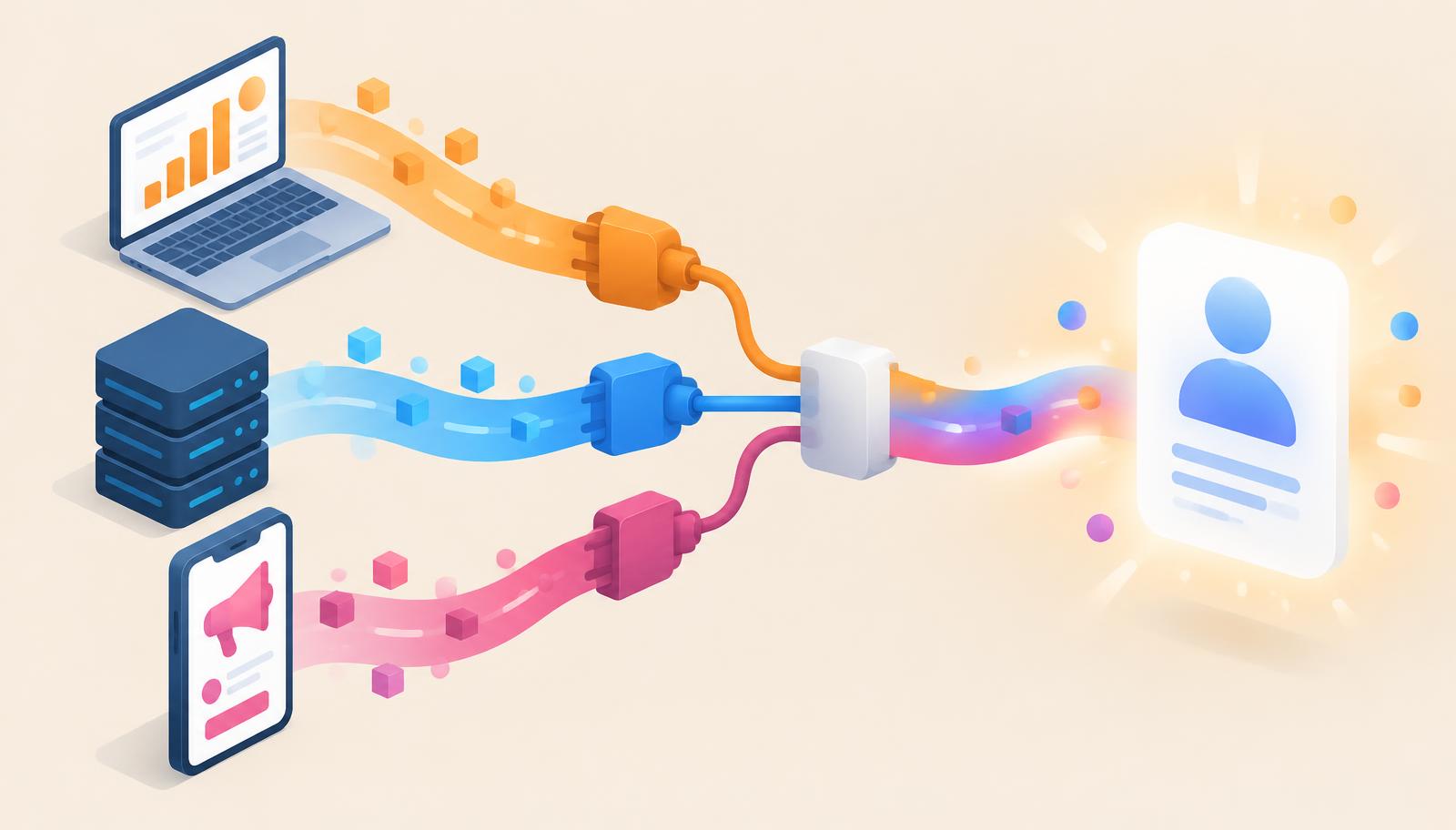
Identity graphs improve cross-channel match confidence by helping us connect scattered identifiers to a fuller customer profile. Instead of treating every email, device signal, phone number, cookie, or business record as a separate person, we can weigh the evidence and decide which connections are reliable enough to act on.
That matters most as Q4 ad costs rise. A duplicate audience, a missed purchaser suppression, or weak retargeting can burn through budget fast. With a customer data unification platform, we can help you recognize the same customer across touchpoints and make smarter choices about where each profile belongs.
A match rate tells you how many records found a possible connection. Match confidence tells you how likely that connection is correct. Those are not the same thing, and confusing them is how teams end up with a large audience file that performs like a small one.
For example, an ecommerce brand may identify a sizable portion of its website visitors. That sounds promising, but the value changes if only a smaller group has recent, channel-ready contact data and strong evidence tying them to the site visit. We would prioritize that stronger group for paid social retargeting or CRM follow-up instead of treating every match as equally useful.
The evidence behind a match matters. We generally think about it in tiers:
- Deterministic identifiers, such as a verified email address or a consistent mobile number
- Connected first-party activity, such as a purchase, form fill, or logged-in website session
- Business information, such as a company email domain, role, or account relationship
- Probabilistic signals, such as device patterns, IP information, or behavioral similarities
Probabilistic signals still have a place. They can help us spot possible relationships and build broader analysis segments. But a shared device or similar behavior should not carry the same weight as a verified email tied to a recent purchase. Match confidence gives you a practical way to decide whether a profile should be activated, enriched, suppressed, or held back.
Build a Customer Data Unification Platform Around Evidence
A customer data unification platform brings your customer information into one working system. Rather than leaving website activity in one tool, purchase history in another, and CRM records somewhere else, we can connect those signals into profiles your marketing and sales teams can actually use.
At DataMoon, we work with identity data, first-party records, website events, CRM activity, purchase behavior, consumer details, business details, and intent signals. The goal is not to create one giant spreadsheet. It is to preserve the relationships between records so you can understand why a profile is connected and how strong that connection is.
An identity graph acts like the relationship map behind the profile. It can connect people, households, emails, phones, devices, addresses, companies, and on-site behavior without pretending every data point belongs to the same person.
Consider a common ecommerce path. A visitor clicks a paid social ad and browses a product page without filling out a form. Later, that person buys with an email address. After the purchase, they call customer support from a mobile number. When the graph links those events with strong evidence, we can treat them as one customer journey.
That creates better decisions across the funnel:
- Suppress the purchaser from acquisition ads
- Move the customer into a post-purchase audience
- Avoid sending a sales offer that no longer fits
- Use the connected profile to understand which campaign started the journey
Without unification, those same events may look like three separate people. The ad platform keeps spending to acquire someone who already bought, the CRM sends a generic prospect email, and support has limited context. None of those errors are dramatic on their own. Together, they create waste.
Activate High-Confidence Profiles Where They Matter
Not every profile should go everywhere. High-confidence matches are usually the best candidates for direct activation because they have enough evidence and the right identifiers for the destination channel.
For paid media, that may mean a consent-aware email address or mobile number that meets the platform’s customer matching requirements. For a CRM, it may mean accurate contact details, a company association, and clear deduplication rules. For outbound, it may mean current business information and a reason to believe the contact is relevant to the account.
A single profile can support several actions, but each action needs its own confidence threshold. We would not use a lightly connected household signal for a personal email campaign. At the same time, that signal may still be useful for measuring audience overlap or spotting broad household-level patterns.
Here is how confidence can shape channel strategy:
- High confidence: CRM audience uploads, suppression lists, sales routing, and outbound sequences
- Medium confidence: audience analysis, enrichment review, and broader ad testing
- Lower confidence: reporting, research, or holding for more supporting signals
- Conflicting data: pause activation until the conflict is resolved
For B2B teams, the difference is especially clear. A visitor may spend time on pricing and integration pages without identifying themselves. If our graph connects that activity to a high-confidence business profile, your team can route the account for review, append missing fields, and check whether the contact already exists in an active opportunity.
That last check matters. Outreach to a contact already speaking with sales is not a sign of persistence. It is usually a sign that systems are not sharing the same picture.
Keep Match Quality High as Data Changes
Identity data does not sit still. People change jobs, replace devices, abandon old email addresses, move, and use different phone numbers over time. Business records shift too, especially when companies hire, reorganize, or change domains.
That is why a customer data unification platform needs ongoing refreshes, recency checks, and clear conflict rules. A profile tied to an old work email should not automatically outrank a newer first-party record. When two data points disagree, we need logic that can recognize the conflict rather than forcing a match because the system wants an answer.
Waterfall match logic helps us work through available identifiers in order. If one identifier does not produce a reliable result, the system can test the next-best option, such as an email, mobile number, postal address, household information, or business data.
The important part is restraint. A waterfall should widen the search without lowering the standard. If the evidence never reaches your confidence threshold, the right action may be to leave the record unmatched.
We recommend monitoring a short quality-control list on a regular schedule:
- Match rate by source, such as website traffic, CRM uploads, or customer files
- Confidence tier distribution across your active audiences
- Duplicate rates and conflicting identifiers
- Recency of emails, phone numbers, and business details
- Channel acceptance rates, opt-out status, and downstream results
Downstream results are where quality becomes real. Watch for changes in conversion rate, ROAS, pipeline creation, unsubscribe activity, and audience overlap. A match is only useful if it leads to a more accurate decision.
Put Match Confidence Into Your Next Q4 Test
Q4 is a good time to test match confidence because waste becomes easier to spot when every impression matters. Start with one clear use case, such as removing recent purchasers from paid social acquisition audiences, enriching high-intent site visitors, or improving CRM audience match quality.
Keep the test simple. Define the audience, set a minimum confidence threshold, activate it in one channel, and compare the result with your existing audience or workflow. That gives you a cleaner read on whether stronger identity evidence changes performance.
The takeaway is straightforward: cross-channel results improve when identity resolution is treated as an evidence problem, not a volume problem. Recognize the right customer, apply the right level of confidence, and choose the next action that fits the data.
Turn Identity Signals Into Better Campaign Decisions
See how DataMoon’s customer data unification platform can help you connect visitor, customer, and audience data with match logic built for activation. We help marketers and sales teams enrich records, build reachable audiences, and send cleaner data to the channels they already use. Start with the signals in your file and determine where better identity coverage can improve your next campaign.